We’ve all been there, or at least heard the horror stories.
You plan an amazing trip with a friend. You’re excited. They’re excited. You both love the destination. This is going to be incredible.
And then… you discover they need to visit every. single. museum. While you’re dying to just wander and find cool coffee shops. Or they want to party until 3am every night, and you’re more of a “sunrise hike” person. Or they’re meticulously budgeting every euro while you’re thinking “we’re on vacation, let’s live a little.”
By day four, you’re silently fantasizing about different flights home.
The thing is, liking the same destination doesn’t mean you’re compatible travel partners. That’s where personality-based matching comes in, and honestly, it’s kind of a game-changer.
The Problem with “We Both Want to Go There”
Traditional ways of finding travel companions focus on the obvious stuff:
- Same destination ✓
- Overlapping dates ✓
- Similar age range ✓
Cool. But none of that tells you whether you’ll actually enjoy traveling together.
Two people can both want to visit Japan in cherry blossom season and have completely different expectations about:
- Wake-up times
- How much planning vs. spontaneity
- Budget for food and accommodation
- Must-see attractions vs. wandering
- How much time together vs. alone time
- What to do when plans fall apart
These “little” things? They make or break trips.
What Personality-Based Matching Actually Looks At
Good travel matching goes deeper than destinations. It considers how you travel and what you need to enjoy the experience.
Your pace: Are you the person with a color-coded itinerary hitting four neighborhoods a day? Or do you prefer waking up with no plans and seeing where the day goes? Both are valid, but mixing them is a recipe for frustration.

Your social battery: Introverts and extroverts can absolutely travel together, but expectations need to match. How much alone time do you need to recharge? How social do you want your nights to be?
Your budget reality: This one’s awkward to talk about, but it matters. If one person is counting every dollar and the other wants to “treat themselves,” tension builds fast.
Your flexibility threshold: When flights get delayed, when that restaurant you researched is closed, when it rains on your beach day, how do you react? Some people roll with it; others spiral. Compatible reactions help.
Your activity preferences: Adventure junkie or spa seeker? Culture vulture or beach bum? Foodie or “food is fuel”? You don’t need identical interests, but major conflicts cause problems.
Not every travel app weighs these the same way, so it’s worth taking a minute to compare the travel companion apps before you commit to one.
What is Big Five travel compatibility?
The Big Five describes five broad personality dimensions: openness, conscientiousness, extraversion, agreeableness and neuroticism. Sorom uses personality responses alongside travel preferences to help compare potential companions. A compatibility score is not a validated prediction of a successful trip, a diagnosis or a safety rating.
These are broad descriptions, not fixed categories. The APA overview of the five-factor model provides background. In everyday terms:
- Openness: How curious and open to new experiences are you?
- Conscientiousness: How organized and detail-oriented?
- Extraversion: How much social energy do you have?
- Agreeableness: How cooperative and considerate toward others?
- Neuroticism: How often do you tend to experience stress or difficult emotions?
Personality responses describe only part of a person. They do not determine food choices, behavior or whether two people will get along. Use the comparison to ask concrete questions about budgets, daily pace and time alone, then decide together.
How Sorom’s ConneXions System Works
We built ConneXions because we got tired of travel compatibility being left to chance.
Here’s how it works:
You take an assessment. Not a boring questionnaire, just enough questions to understand your travel personality, style preferences, and what matters to you.
We look at multiple dimensions. Core personality, travel style, communication preferences, budget, pace, interests. The stuff that actually affects whether you’ll have a good time together.
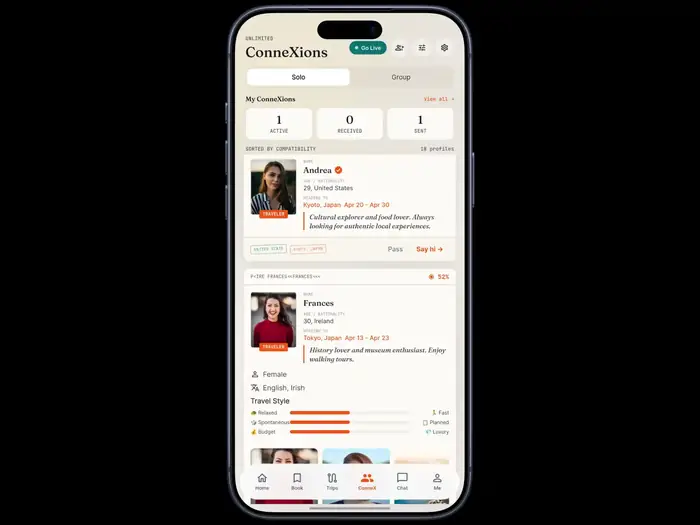
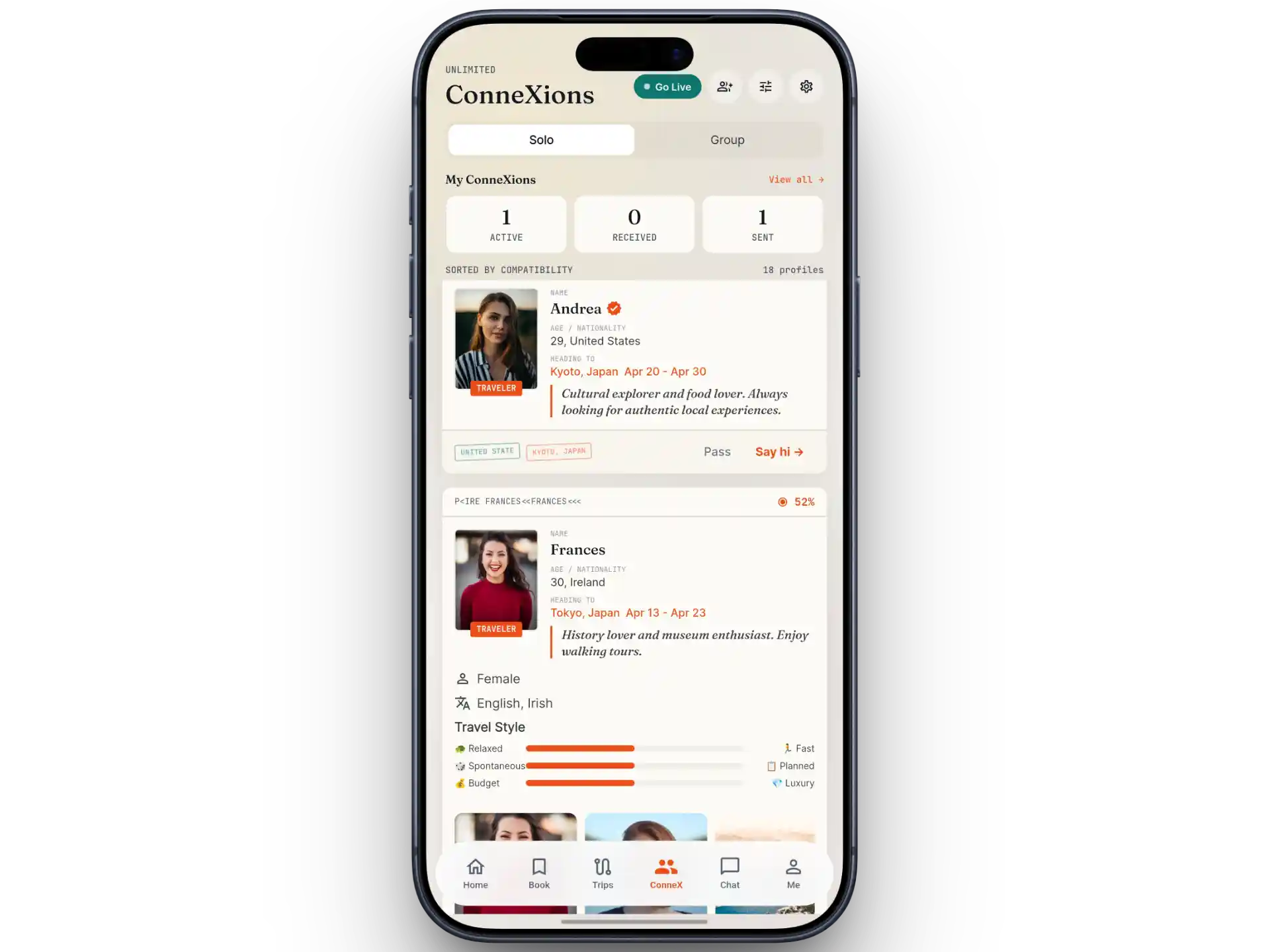
You get compatibility scores. When you browse potential travel companions, you see not just who matches your destination interests, but how compatible you are across different dimensions.
The breakdown helps you decide. Maybe you’re 90% compatible overall, but there’s a budget mismatch you should discuss. Better to know upfront than discover it at a fancy restaurant when the bill comes.
Look for ID verification. Sorom offers Medallion identity verification, and Annual members can filter matches to verified travelers only.
Why This Actually Matters
Discuss differences early. A comparison can highlight topics worth discussing before the trip. You still need to agree how you will make decisions and handle disagreements.
Make room for both people. Shared interests can help you choose activities, while time apart gives each person space to do something different.
Leave room for friendship. A trip can create opportunities to connect. Friendship develops through the experience itself, not through a score.
Set expectations before departure. Clear conversations can make uncertainties easier to discuss. A high score does not remove the need to take precautions or decide whether meeting feels right.
Making Matching Work For You
Even with great technology, there are ways to maximize your chances of finding ideal travel companions:
Be honest in your assessment. Don’t answer based on who you think you should be. Answer based on how you actually travel. The algorithm can’t help you if you give it fiction.
Read full profiles. Compatibility scores are useful, but people are complex. Read what they’ve written, look at their interests, get a sense of who they are beyond the numbers.
Communicate before committing. Use chat features to have real conversations. Ask specific questions. Get a feel for whether this person is someone you’d enjoy spending time with.
Start small if you can. If possible, meet for coffee first or plan a shorter trip before committing to something big.
Talk about expectations. Even with high compatibility, explicit conversations about budget, pace, and must-dos prevent misunderstandings.
Beyond Matching: Making It Work
Finding a compatible match is step one. Successful travel partnerships also require:
- Ongoing communication. Check in during the trip. How are you feeling? What’s working? What’s not?
- Flexibility from both sides. No two people agree on everything. Compromise is still required.
- Addressing issues early. Small frustrations become big problems if you let them fester.
- Appreciating differences. Sometimes a travel companion introduces you to something you never would have tried alone.
Does personality matching work for groups?
Sorom also uses compatibility information in group ConneXions. Treat it as a starting point for a group discussion: people can have different budgets, pace and interests even when an overall score looks high. Group matching and messaging take place in the mobile app.
And when you just want company for one afternoon rather than a whole trip, Circles let you host or join a nearby group activity, a food crawl, a museum walk, a hike, with a set time, an exact meeting point, and its own group chat. Joining Circles is free on every plan.
Ready to Find Your Match?
Use profile comparisons to find potential travel companions, then talk before committing. Start with a public meeting or a short shared activity when possible.
Your next trip could be your best one yet, not despite your companion, but because of them. And if you’re wondering where to use it, some destinations are perfect for meeting travel companions.
Download Sorom and discover our ConneXions matching system. Find travel companions who actually match your style.
Spread the word